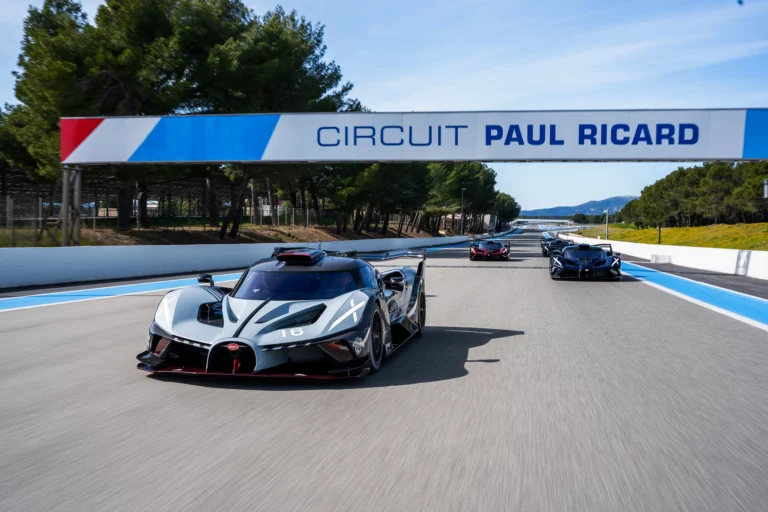
Located on the sun-drenched plateau of Le Castellet, the Paul Ricard Circuit is one of the world’s most advanced permanent motorsport venues. Combining a rich Grand Prix heritage with cutting-edge testing facilities, the circuit has become an international centre for competition, engineering, vehicle development and driver training.
Opened in 1970 through the vision of French entrepreneur Paul Ricard, the circuit has hosted Formula One, endurance racing, motorcycle championships and countless private development programmes. Today it remains one of the most versatile circuits ever constructed, capable of operating in more than one hundred different configurations while supporting manufacturers and racing teams from around the globe.
In Brief
- The circuit opened in 1970.
- It was commissioned by French entrepreneur Paul Ricard.
- More than 160 circuit configurations are possible.
- The Mistral Straight is one of Europe’s longest racing straights.
- The blue and red run-off zones became a benchmark for modern circuit safety.
- The venue evolved into the renowned High Tech Test Track before Formula One returned in 2018.
History
The Paul Ricard Circuit opened in 1970 after being commissioned by drinks entrepreneur Paul Ricard, who envisioned a world-class racing facility in southern France.
Almost immediately the circuit became home to the French Grand Prix, attracting many of the sport’s greatest drivers throughout the 1970s and 1980s. Its exceptionally long Mistral Straight and sweeping Signes corner quickly earned a reputation as one of Formula One’s fastest combinations.
Following the decline of Grand Prix racing during the 1990s, the circuit underwent an extraordinary transformation. Rebuilt as the High Tech Test Track, Paul Ricard pioneered extensive asphalt run-off areas, advanced safety barriers and modular circuit configurations, becoming one of the world’s leading private testing facilities.
Formula One returned in 2018, reaffirming the circuit’s position among the sport’s most important venues.
Circuit Design
The current Grand Prix configuration measures 5.842 kilometres and features 15 corners, arranged in a clockwise direction.
Its defining characteristic is versatility. More than 160 possible layouts allow manufacturers, racing teams and organisers to configure the circuit for virtually every category of motorsport.
The famous Mistral Straight, interrupted today by a chicane for Grand Prix competition, remains one of Europe’s longest straights. Combined with the ultra-fast Signes corner and the highly technical final sector, the circuit offers an exceptional balance of high-speed performance, braking stability and mechanical grip.
Equally distinctive are the circuit’s blue and red high-friction run-off zones, developed to improve safety while reducing reliance on traditional gravel traps.
LENGTH
5.752
kilometres
WIDTH
10–12
metres
DIRECTION
CW
clockwise
TURNS
13
5 left – 8 right
SURFACE
Asphalt
LONGEST STRAIGHT
1,860
metres
ELEVATION CHANGE
35.9
metres
OPENED
1970
56 years ago
Circuit Paul Ricard is defined by the contrast between its long acceleration zones, technical corner sequences and the exceptionally fast Signes corner. The opening section through Sainte-Baume combines medium-speed direction changes with slower corners, requiring accurate positioning and strong traction before the circuit begins its characteristic run towards the Mistral Straight.
The Mistral Straight leads towards Signes, one of Paul Ricard’s defining corners, where high speed places considerable demands on aerodynamic stability and commitment. The following Beausset right-hander produces sustained lateral loading before the circuit becomes progressively more technical through Bendor and the final sequence, where precision and traction again become important.
Paul Ricard’s challenge therefore comes from adapting between very different forms of cornering within the same lap. Strong performance requires straight-line efficiency, stability through extremely fast sections and mechanical grip through slower technical corners, making the circuit particularly effective at exposing weaknesses in overall vehicle balance.
| Corner |
|---|
| C1 · S de la Verrerie |
| T1 073° · Left · 36 m |
| T2 066° · Right · 63 m |
| T3 066° · Right · 31 m |
| T4 100° · Left · 84 m |
| T5 111° · Right · 22 m |
| T6 138° · Right · 212 m |
| T7 046° · Left · 47 m |
| T8 070° · Right · 188 m |
| T9 205° · Right · 309 m |
| T10 158° · Left · 165 m |
| T11 041° · Right · 201 m |
| T12 136° · Left · 170 m |
| T13 127° · Right · 36 m |
Visitor Experience
Visitors experience a circuit unlike any other in Europe.
Major race weekends combine international competition with excellent spectator facilities overlooking the Mistral Straight and Signes, while throughout the year the venue hosts manufacturer experiences, track days, driving schools and engineering programmes.
The surrounding Provence region adds another dimension, allowing visitors to combine motorsport with vineyards, Mediterranean cuisine and the picturesque hilltop villages of southern France.
Climate
| Month | High °C | Low °C | Rainfall mm | Rainy days | Daylight h |
|---|---|---|---|---|---|
| January | 9° | 3° | 63 | 8 | 9.4 |
| February | 10° | 2° | 51 | 7 | 10.5 |
| March | 13° | 5° | 48 | 7 | 12.0 |
| April | 15° | 7° | 68 | 9 | 13.4 |
| May | 19° | 11° | 57 | 8 | 14.7 |
| June | 24° | 15° | 35 | 6 | 15.3 |
| July | 27° | 17° | 17 | 3 | 15.0 |
| August | 27° | 17° | 20 | 3 | 13.9 |
| September | 22° | 14° | 71 | 7 | 12.5 |
| October | 18° | 11° | 97 | 9 | 11.0 |
| November | 13° | 7° | 112 | 11 | 9.7 |
| December | 10° | 4° | 72 | 9 | 9.0 |
Monthly averages for Paul Ricard Circuit, 1991–2020.
Generated using Copernicus Climate Change Service information 2026 (CC BY 4.0).
Neither the European Commission nor ECMWF is responsible for any use that may be made of the Copernicus information or data it contains.
Location
The Paul Ricard Circuit is located near Le Castellet, approximately 40 kilometres east of Marseille and 25 kilometres north of Toulon.
Positioned between the Mediterranean coast and the vineyards of Provence, the circuit enjoys one of the most scenic settings in international motorsport.
Address
Route des Hauts du Camp 2760
83330 Le Castellet
Var, Provence-Alpes-Côte d'Azur
France
Website