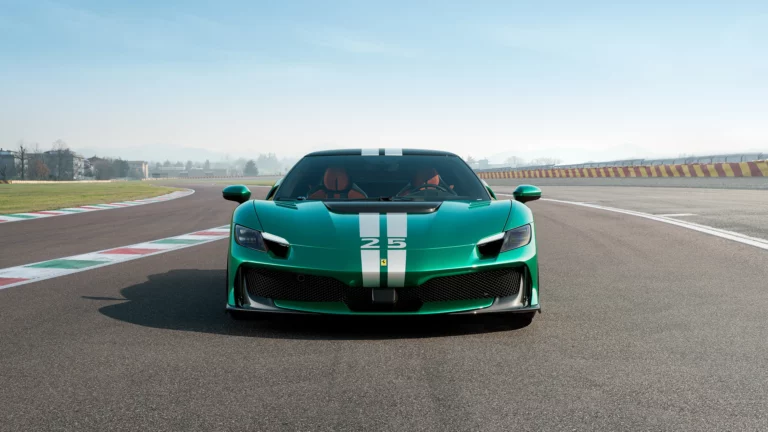
Hidden behind the gates of Ferrari’s headquarters in Maranello, Fiorano Circuit is one of the most exclusive and influential test tracks in the automotive world. Unlike conventional racing circuits, Fiorano was built specifically to develop Ferrari’s Formula One cars, GT racers and production road vehicles under the direct supervision of the company’s engineers.
Opened in 1972 at the request of Enzo Ferrari, the circuit has served as Ferrari’s private proving ground for more than five decades. Every generation of Ferrari engineers, test drivers and Formula One champions has contributed to its history.
Although closed to public competition, Fiorano has arguably shaped more Ferrari victories than any circuit on the Formula One calendar.
In Brief
- Fiorano was built at the personal request of Enzo Ferrari in 1972.
- Nearly every modern Ferrari Formula One car has been tested at Fiorano.
- Every major Ferrari road car of the past five decades has undergone development on the circuit.
- The layout was designed specifically to reproduce a wide variety of racing conditions within a single lap.
- The circuit is directly connected to Ferrari’s headquarters, allowing engineers to move rapidly between factory and track.
- Unlike almost every famous circuit in the world, Fiorano has never been intended for public competition.
History
During the late 1960s, Ferrari relied upon public circuits such as Modena and Monza for vehicle development. Enzo Ferrari believed that the company required a dedicated facility where engineers could conduct testing in complete secrecy while accelerating the pace of development.
Construction began adjacent to the Ferrari factory in Maranello, and Fiorano officially opened in 1972.
The circuit immediately became central to Ferrari’s Formula One programme. Legendary drivers including Niki Lauda, Gilles Villeneuve, Michael Schumacher, Kimi Räikkönen and Charles Leclerc have all completed thousands of development laps at Fiorano.
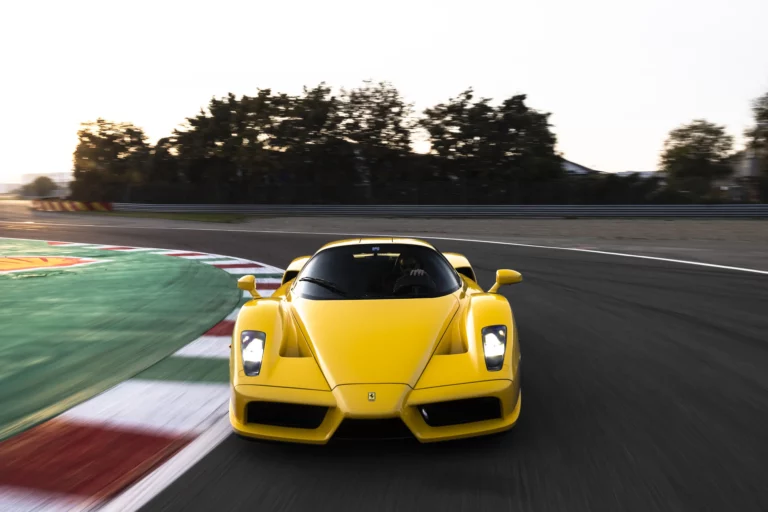
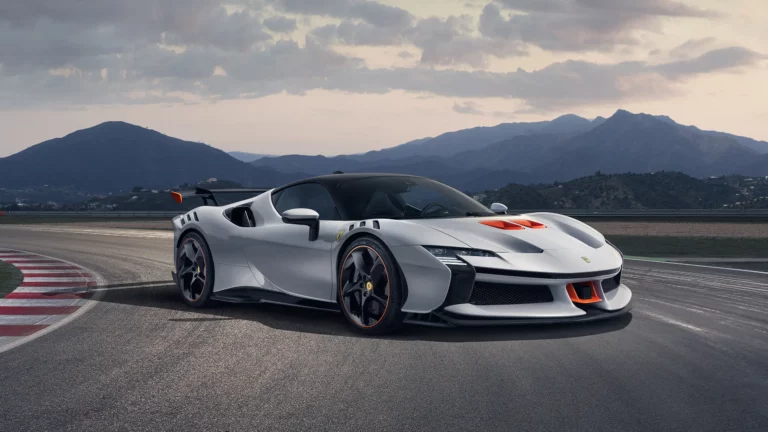
The circuit also became the birthplace of Ferrari’s modern road cars. From the Ferrari F40 and Ferrari F50 to the Ferrari Enzo, Ferrari LaFerrari, Ferrari SF90 Stradale and Ferrari F80, nearly every modern Ferrari has been refined here before reaching customers.
Today Fiorano remains the centre of Ferrari’s development philosophy.
Circuit Design
Fiorano measures approximately 2.997 kilometres and was intentionally designed to replicate the characteristics of multiple international racing circuits within a compact layout.
Fiorano was created specifically as Ferrari’s private development circuit, opening in 1972 immediately beside the company’s Maranello facilities. Rather than reproducing a conventional racing circuit, its compact layout was designed to expose vehicles to a broad range of dynamic conditions within a controlled environment where engineers could repeatedly evaluate changes and compare results.
The circuit combines corners of different radii with braking, acceleration and transitional sections intended to examine mechanical grip, chassis balance, power delivery and aerodynamic behaviour. Its proximity to Ferrari’s engineering facilities allows development cars to move directly between factory and track, making Fiorano effectively an extension of the engineering environment rather than a separate motorsport venue.
Successive upgrades have introduced increasingly sophisticated testing infrastructure while preserving this fundamental purpose. Fiorano’s design is therefore best understood not as a circuit created primarily for competition or spectators, but as a specialised engineering instrument expressed in the form of a racetrack.
LENGTH
2.976
kilometres
WIDTH
8
metres
DIRECTION
CW
clockwise
TURNS
13
5 left – 8 right
SURFACE
Asphalt
LONGEST STRAIGHT
591
metres
ELEVATION CHANGE
11.7
metres
OPENED
1972
54 years ago
Fiorano is defined by its compact, technical character and the unusually concentrated variety of conditions incorporated into a short lap. Fast and slow corners, changes of direction and repeated acceleration and braking phases place emphasis on vehicle balance and responsiveness rather than outright speed, reflecting the circuit’s primary purpose as a development facility.
The opening section quickly establishes this rhythm before the circuit progresses through tighter corners requiring accurate braking and strong traction. Faster sections allow aerodynamic behaviour and stability to be assessed, while the more technical sequences expose weaknesses in mechanical grip, steering response and power delivery. With little distance separating these different demands, each section follows rapidly into the next.
Although Fiorano is not defined by celebrated individual corners in the manner of a Grand Prix circuit, its challenge comes from compressing numerous aspects of vehicle performance into one continuous lap. Precision and consistency are particularly important, allowing small changes in setup or vehicle behaviour to be identified repeatedly under controlled conditions.
| Corner |
|---|
| T1 092° · Right · 32 m |
| T2 049° · Right · 117 m |
| T3 099° · Right · 141 m |
| T4 105° · Left · 193 m |
| T5 119° · Right · 60 m |
| T6 088° · Right · 54 m |
| T7 021° · Left · 103 m |
| T8 183° · Left · 45 m |
| T9 033° · Right · 201 m |
| T10 063° · Left · 154 m |
| T11 020° · Right · 93 m |
| T12 186° · Left · 112 m |
| T13 017° · Right · 89 m |
Fiorano occupies a unique position in motorsport because its importance comes not from the races it has hosted, but from the Ferrari racing and road cars developed there. Since opening in 1972, the circuit has served as Ferrari’s principal private test track, connecting the company’s Maranello engineering facilities directly with real-world vehicle development.
Generations of Ferrari Formula One cars have been tested at Fiorano, placing the circuit behind decades of Grand Prix development and championship competition. Ferrari’s racing drivers have consequently spent countless kilometres there evaluating new cars, components and setups, while the circuit has also played an important role in the development and validation of the company’s production and limited-series road cars.
Its significance therefore extends beyond conventional circuit history. Fiorano represents the unusually close relationship between competition, engineering and road-car development that has characterised Ferrari throughout its history. Few circuits are so closely identified with a single manufacturer, making Fiorano not simply a test facility beside Maranello but an integral part of Ferrari’s engineering and motorsport identity.
Visitor Experience
Fiorano is a private facility and is not generally open to public driving or unrestricted access. Nevertheless, visitors to Maranello can often catch glimpses of the circuit from surrounding public roads, occasionally witnessing development cars or Formula One machinery undergoing testing.
The circuit forms part of a wider Ferrari pilgrimage that includes the Museo Ferrari, the historic Ferrari factory, the town of Maranello and the broader Motor Valley. Together, these locations offer enthusiasts an unparalleled insight into one of the world’s most celebrated automotive brands.
Climate
| Month | High °C | Low °C | Rainfall mm | Rainy days | Daylight h |
|---|---|---|---|---|---|
| January | 7° | 0° | 61 | 9 | 9.3 |
| February | 9° | 0° | 79 | 9 | 10.5 |
| March | 13° | 3° | 80 | 9 | 12.0 |
| April | 17° | 7° | 97 | 12 | 13.5 |
| May | 21° | 11° | 101 | 12 | 14.8 |
| June | 26° | 15° | 76 | 9 | 15.5 |
| July | 29° | 18° | 56 | 7 | 15.2 |
| August | 28° | 18° | 68 | 9 | 14.0 |
| September | 23° | 14° | 91 | 10 | 12.5 |
| October | 18° | 10° | 102 | 11 | 11.0 |
| November | 12° | 5° | 114 | 12 | 9.6 |
| December | 8° | 1° | 85 | 10 | 8.9 |
Monthly averages for Fiorano Circuit, 1991–2020.
Generated using Copernicus Climate Change Service information 2026 (CC BY 4.0).
Neither the European Commission nor ECMWF is responsible for any use that may be made of the Copernicus information or data it contains.
Location
Fiorano Circuit is located immediately adjacent to Ferrari’s headquarters in Maranello, approximately 20 kilometres south of Modena.
Its position at the heart of Italy’s Motor Valley places it within minutes of numerous legendary manufacturers, suppliers and engineering companies.
Address
Via Gilles Villeneuve
41042 Fiorano Modenese
Provincia di Modena, Emilia-Romagna
Italy