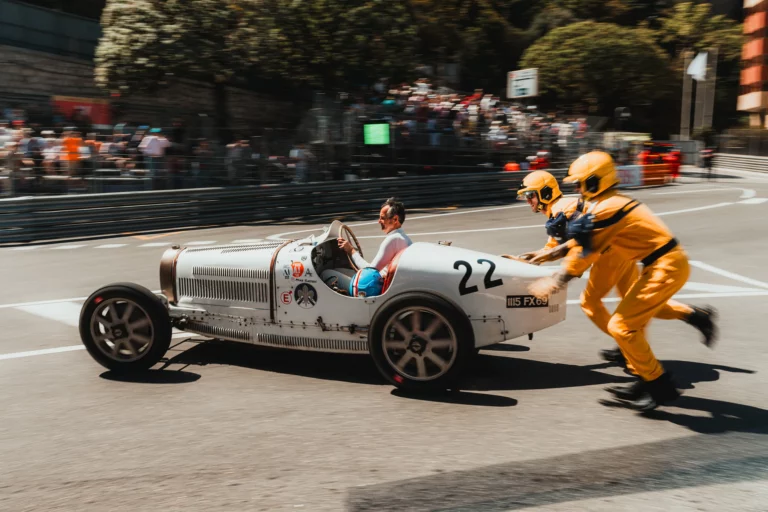
Threading through the narrow streets of Monaco, the Monaco Circuit is the world’s most iconic street racing venue and one of the most prestigious circuits in all of motorsport. Since first hosting Grand Prix racing in 1929, the circuit has become synonymous with Formula One itself, combining extraordinary history, breathtaking scenery and one of the greatest driving challenges ever created.
Unlike purpose-built circuits, Monaco transforms the streets of the Principality into a temporary racing venue where competitors navigate narrow barriers, elevation changes, harbourfront boulevards and some of the most famous corners in motorsport.
Victory in Monaco is regarded as one of the highest achievements in a driver’s career, forming one leg of the celebrated unofficial Triple Crown of Motorsport alongside the Indianapolis 500 and the 24 Hours of Le Mans.
In Brief
- The Monaco Grand Prix was first held in 1929.
- Monaco formed part of Formula One’s inaugural World Championship season in 1950.
- Ayrton Senna holds the record with six Monaco Grand Prix victories.
- The Fairmont Hairpin is the slowest corner in Formula One.
- The circuit features the only tunnel on the Formula One calendar.
- Winning Monaco forms one leg of the unofficial Triple Crown of Motorsport.
History
The Monaco Grand Prix was first organised in 1929 under the leadership of Antony Noghès with the support of Prince Louis II. From the outset, the race attracted Europe’s finest drivers and manufacturers, establishing Monaco as one of the continent’s premier sporting events.
The circuit became part of the inaugural Formula One World Championship in 1950 and has remained one of the championship’s defining races ever since. Legends including Juan Manuel Fangio, Graham Hill, Ayrton Senna, Michael Schumacher and Lewis Hamilton have all written unforgettable chapters in Monaco’s history.
Among them, Ayrton Senna’s six victories remain the benchmark of mastery around the Principality, earning him the enduring title of the “King of Monaco.”
Circuit Design
The modern circuit measures 3.337 kilometres and consists of 19 corners arranged in a clockwise direction.
Despite being the shortest lap on the Formula One calendar, Monaco remains one of the most technically demanding. The layout climbs from the harbour towards Casino Square before descending through the famous Fairmont Hairpin, the tunnel and the waterfront chicane.
Every metre of the circuit is bordered by Armco barriers, leaving virtually no margin for error. The narrow width prevents multiple racing lines across much of the lap, making qualifying performance critically important.
Unlike conventional circuits, Monaco was never designed for racing. The roads themselves define the circuit, preserving the unique character that has remained largely unchanged for nearly a century.
LENGTH
3.337
kilometres
WIDTH
7–12
metres
DIRECTION
CW
clockwise
TURNS
19
8 left – 11 right
SURFACE
Asphalt
LONGEST STRAIGHT
425
metres
ELEVATION CHANGE
41.8
metres
OPENED
1929
97 years ago
Corner Guide
Monaco is defined less by outright speed than by precision, positioning and rhythm within an exceptionally confined environment. The opening climb through Sainte Dévote and Beau Rivage leads towards Massenet and Casino Square, where elevation, limited visibility and narrow barriers leave little margin for correcting an imperfect line.
The lap then descends through Mirabeau towards the Grand Hotel Hairpin, the slowest corner on the circuit, before Portier determines the crucial acceleration through the tunnel. The heavy braking for the Nouvelle Chicane provides one of the principal overtaking opportunities, while Tabac and the Swimming Pool sequence demand considerably greater commitment and rapid changes of direction.
Monaco’s defining challenge comes from linking these very different corners while remaining continuously close to walls and barriers. With overtaking difficult and mistakes heavily punished, performance depends upon accuracy, confidence and consistency, making qualifying and track position unusually important.
| Corner |
|---|
| T1 · Sainte Devote 066° · Right · 76 m |
| T2 · Beau Rivage 018° · Left · 22 m |
| T3 · Massenet 131° · Left · 199 m |
| T4 · Casino 087° · Right · 65 m |
| T5 · Mirabeau Haute 143° · Right · 53 m |
| T6 · Grand Hotel Hairpin 192° · Left · 36 m |
| T7 · Mirabeau Bas 108° · Right · 33 m |
| T8 · Portier 100° · Right · 18 m |
| T9 · Tunnel 049° · Right · 235 m |
| C1 · Nouvelle Chicane |
| T10 019° · Left · 28 m |
| T11 008° · Right · 32 m |
| T12 · Tabac 054° · Left · 14 m |
| C2 · Piscine |
| T13 · Louis Chiron 051° · Left · 18 m |
| T14 047° · Right · 24 m |
| T15 066° · Right · 19 m |
| T16 075° · Left · 22 m |
| T17 · La Rascasse 140° · Right · 37 m |
| C3 · Anthony Noghes |
| T18 096° · Right · 24 m |
| T19 039° · Left · 28 m |
The Monaco Grand Prix, first held in 1929, became one of international motor racing’s most celebrated events and has formed part of the Formula One World Championship since its inaugural 1950 season. Its long history connects contemporary Formula One directly with the European tradition of racing through public streets.
Monaco has produced some of Formula One’s defining performances, with Ayrton Senna’s record six victories particularly associated with the circuit. Winning there has traditionally carried significance beyond championship points because its confined layout places exceptional emphasis on driver precision, qualifying performance and sustained concentration.
Together with the Indianapolis 500 and 24 Hours of Le Mans, Monaco forms motorsport’s traditional Triple Crown, giving victory a place within a much broader history of international competition. Its combination of sporting heritage, distinctive urban setting and continuity makes Monaco one of the most recognisable symbols of Grand Prix racing itself.
Visitor Experience
Attending the Monaco Grand Prix is unlike visiting any other race.
Spectators watch Formula One cars pass between luxury yachts, historic buildings and Mediterranean cafés while the Principality transforms into the centre of the motorsport world. Grandstands overlook the harbour, balconies become private viewing terraces and superyachts create floating hospitality suites.
Outside race sessions, visitors can explore the Prince’s Palace of Monaco, Casino de Monte-Carlo, Oceanographic Museum of Monaco and the picturesque streets that form the circuit itself.
Walking the lap remains one of motorsport’s essential pilgrimages.
Climate
| Month | High °C | Low °C | Rainfall mm | Rainy days | Daylight h |
|---|---|---|---|---|---|
| January | 9° | 3° | 73 | 9 | 9.4 |
| February | 9° | 3° | 62 | 8 | 10.5 |
| March | 12° | 5° | 69 | 9 | 12.0 |
| April | 14° | 8° | 89 | 13 | 13.5 |
| May | 18° | 12° | 74 | 13 | 14.7 |
| June | 22° | 15° | 62 | 12 | 15.4 |
| July | 24° | 18° | 38 | 10 | 15.1 |
| August | 25° | 19° | 37 | 9 | 13.9 |
| September | 21° | 15° | 79 | 10 | 12.5 |
| October | 17° | 12° | 112 | 11 | 11.0 |
| November | 13° | 7° | 135 | 11 | 9.7 |
| December | 10° | 4° | 89 | 9 | 9.0 |
Monthly averages for Monaco Circuit, 1991–2020.
Generated using Copernicus Climate Change Service information 2026 (CC BY 4.0).
Neither the European Commission nor ECMWF is responsible for any use that may be made of the Copernicus information or data it contains.
Location
The Monaco Circuit winds through the streets of Monaco on the Mediterranean coast between France and the Ligurian Sea.
The circuit lies only a short distance from Nice Côte d’Azur Airport and is easily reached by road, rail and helicopter.
Address
11 Boulevard Albert 1er
98000 Monaco
Monaco
Website