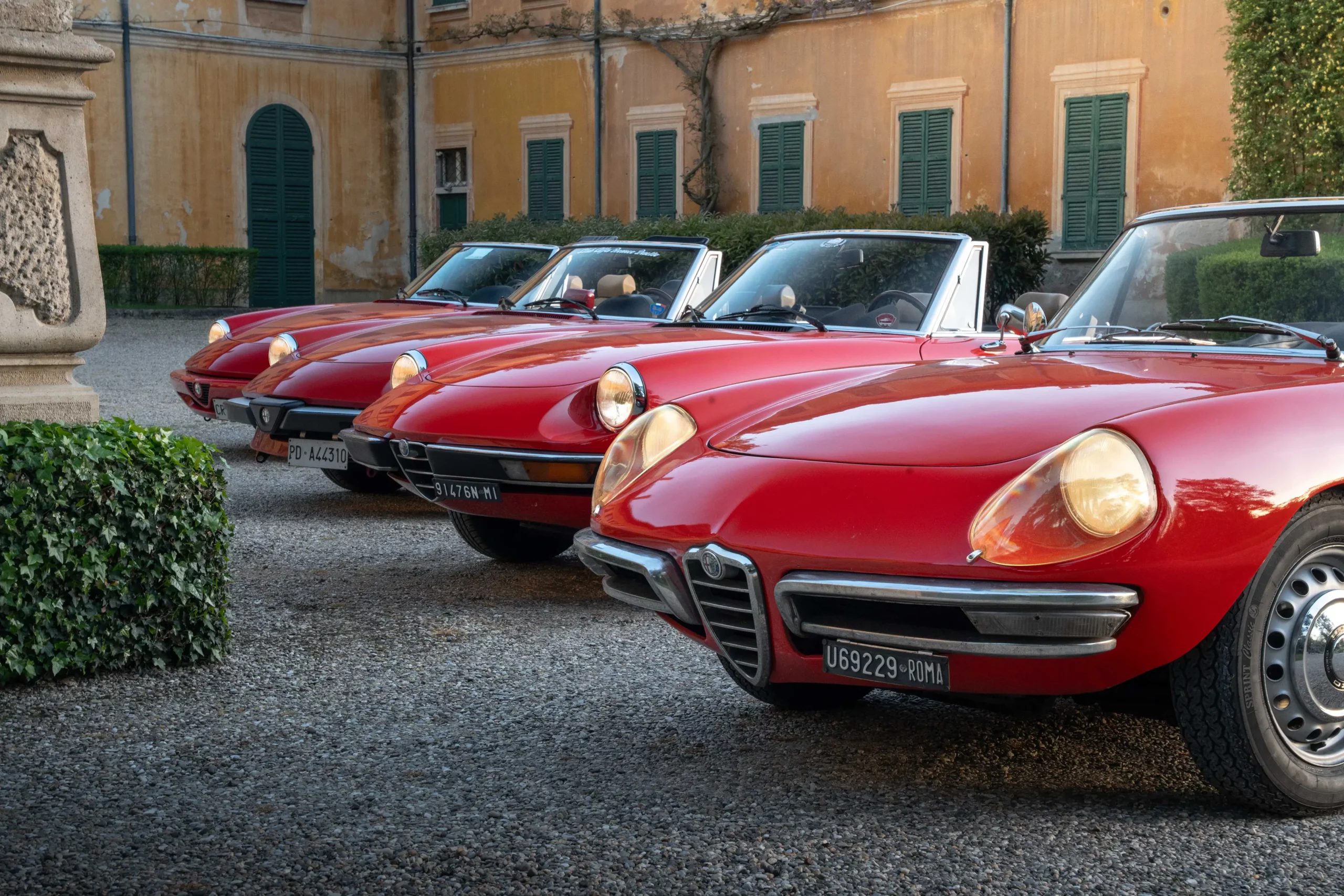
Sixty years ago, at the 1966 Geneva Motor Show, Alfa Romeo presented a car destined to become an icon: the legendary 1600 Spider. It has become known by enthusiasts all over the world as ‘Duetto’, an unofficial name that has entered common usage since its launch. The appeal of the Alfa Romeo Spider shows no sign of diminishing, as evidenced by the success of the recent gathering at the Alfa Romeo Museum in Arese.
Hundreds of Alfisti fans came together from all over Italy – and beyond – to celebrate its 60th anniversary. For Alfa Romeo, its glorious past is an active, identifying value, as well as a source of constant inspiration for the future. This is the perspective adopted by ‘The Story’, the division focusing on the outstanding new BOTTEGAFUORISERIE project, which is dedicated to the conservation, restoration and leveraging of the Italian brand’s heritage. It safeguards the artisanship and cultural skills that ensure continuity between the cars that made history for the Biscione brand and those due to write its upcoming chapters.
In Brief
- At the 1966 Geneva Motor Show, Alfa Romeo presented the 1600 Spider, better known as the Duetto, produced until 1994 in four distinct series
- With over 124,000 units sold and a 28-year career, it is the longest-lived and most popular Alfa Romeo model around the world
- The Alfa Romeo Museum in Arese celebrates the anniversary with a ‘Spider is Alfa Romeo’ exhibition, open throughout the rest of 2026
- Structured into four themed stages – one for each model series – the event launched on Sunday 19th April, with a large parade of spiders from all over Europe
Celebrations at the Alfa Romeo Museum, Arese
On Sunday, 19th April, the Alfa Romeo Museum in Arese held a day of celebrations for the anniversary of the Spider, including a parade of the most significant models and a lecture on an iconic car that remains one of the best loved by Alfisti from all over the world. The afternoon witnessed the opening of the ‘Spider is Alfa Romeo’ exhibition, where enthusiasts can put their cars on show within the Museum throughout the rest of 2026. The exhibition is divided into four themed stages, each focusing on one of the Spider series.
- Cuttlefish bones: April – June
- Truncated Tail: July – August
- Aerodynamics: September – October
- Final 1990 restyling: November – December
The exciting program transforms the Museum into a living, breathing venue where the Biscione brand’s official history is intertwined with the stories of Alfisti fans and their cars, in a collective embrace encompassing memory and passion.
Origins of a Made in Italy masterpiece
In the mid-1960s, Alfa Romeo management decided to produce an heir to the Giulietta Spider, a model that had won over the United States by embodying a different way of life. An ambitious goal, it was entrusted to the hand of Pininfarina, the author of the Giulietta Spider a decade earlier. For the new car, the Turin atelier took as its starting point the mechanics of the Giulia Sprint GT. Its wheelbase was reduced to 2,250mm and all its dynamic features – performance, acceleration and road holding – maintained. This included high-level mechanical specifications such as independent front suspension, five-speed gearbox, rear-wheel drive and four-disc brakes.
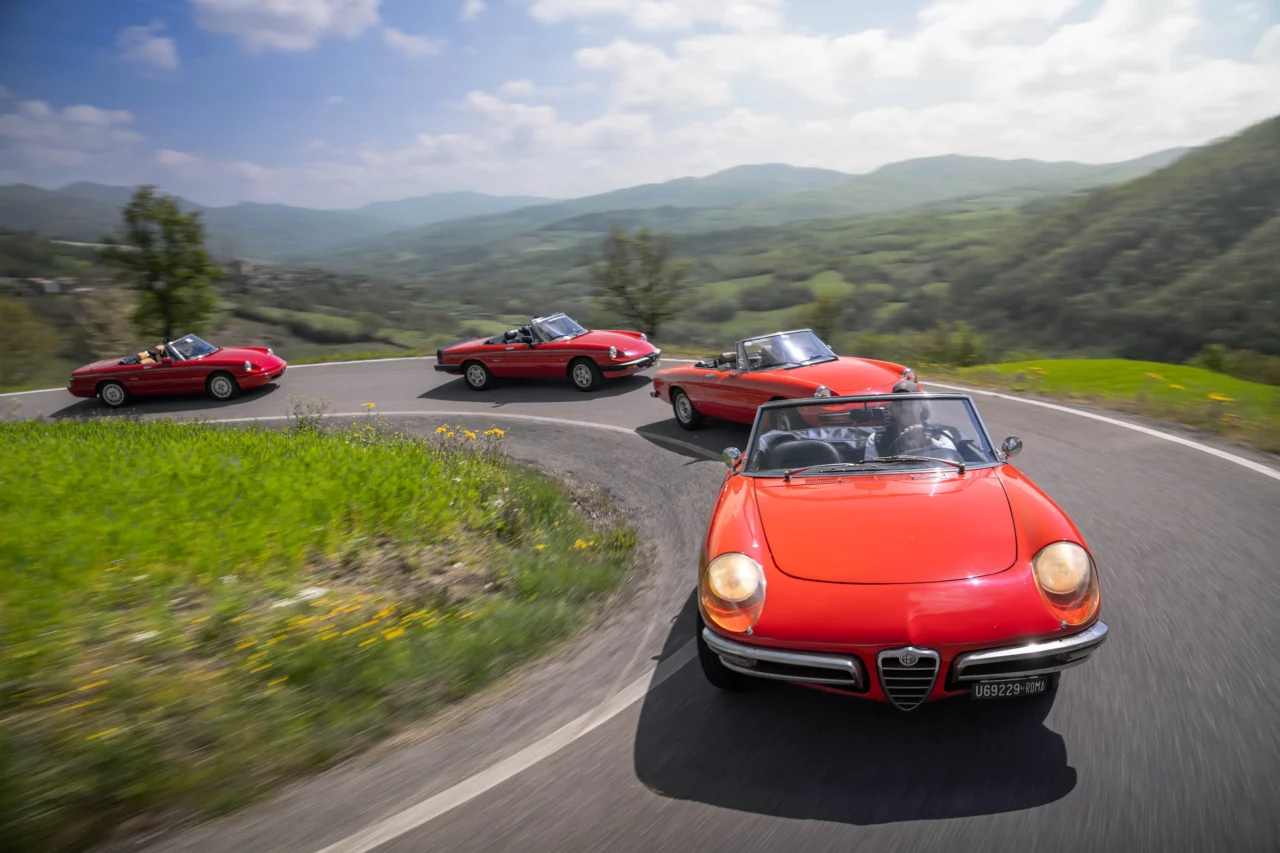
The interior reflected the typical 1960s Alfa Romeo layout, a three-spoke ‘chalice’ steering wheel, two generously sized dials in front of the driver, three smaller diameter dials in the middle of the dashboard and an almost horizontal gear stick with exceptional manoeuvrability. The low, slender bodywork with rounded front and tail included bumpers in two parts to emphasise the typical Alfa Romeo badge in the centre, while wide grooves ran along the low sides to modernise the lines.
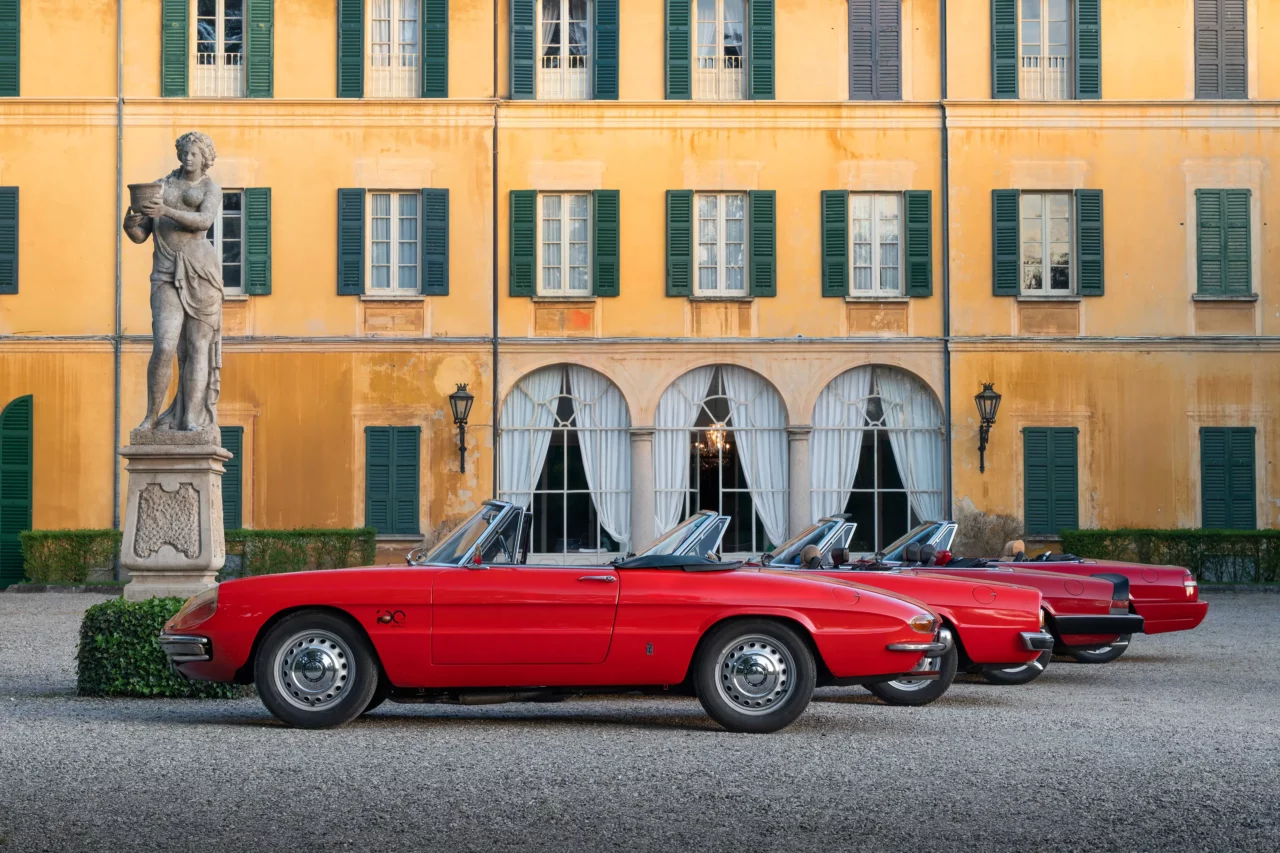
The curb weight of only 990kg meant it could reach a top speed of 115mph. The engines in the line-up, developed over the years around the legendary Alfa Romeo four-cylinder twin-cam, are available with four displacements – 1600 (1,570 cc), 1750 (1,779 cc), 1300 (1,290 cc) and 2000 (1,962 cc), with carburetor supply, ‘Spica’ mechanical injection, and latterly electronic injection.
Four series, one personality
For the 1966 launch of the 1600 Spider, Alfa Romeo dreamed big – a cruise on the Italian turboship Raffaello from Genoa to New York, with a stopover in Cannes for its Film Festival. There were 1,300 VIPs on board with three new Spider models on display on deck, all made available for dynamic tests.
Success in the U.S. was immediate and extraordinary, so much so that it then went into use as a prop car in hundreds of film and television productions. Although ‘Duetto’ was never the official name, a competition was launched in conjunction with dealerships to name the new spider; the winner was ‘Duetto’. However, that name was a registered trademark, so Alfa Romeo let Duetto remain in the memories of enthusiasts. It would later become the commonly used moniker for every generation of the car. Over the years, the Spider remained one of the very few of its type in its market segment, acquiring such an identity of its own that the noun ended up becoming a proper name: simply, Spider.
The first series (1966-1969) – nicknamed ‘Cuttlefish Bone’ for its ellipsoidal bodywork of a rounded front and tail and convex sides – was the last creation overseen by Battista ‘Pinin’ Farina and the most sought after by collectors.
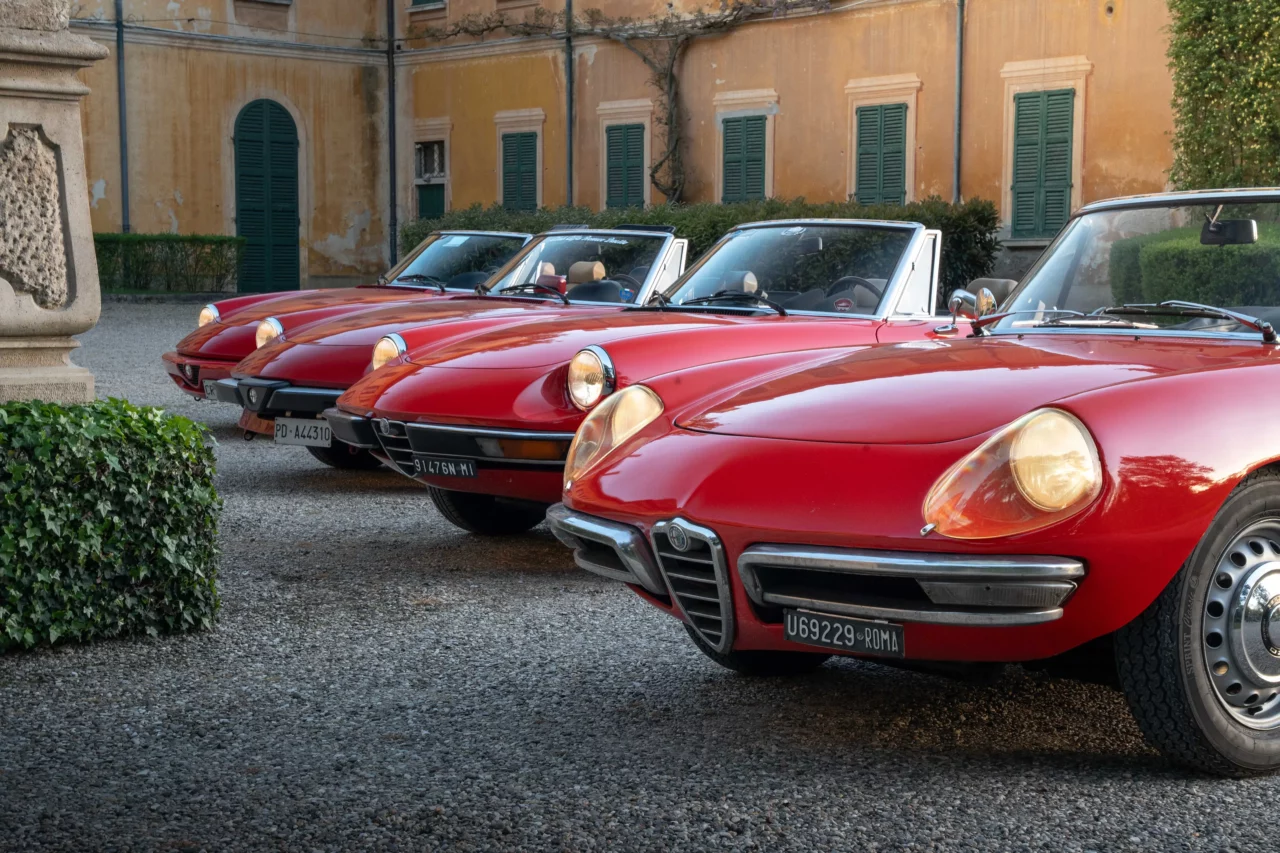
From 1969 onwards, the silhouette was updated with a clean cut at the rear, which earned the second series the moniker of ‘truncated tail’ (1969-1982). The longest-standing and best-selling series, almost 50,000 units were sold, including the 1978 Niki Lauda Special Edition made for the American market as a tribute to the Austrian champion, then at the wheel of Alfa Romeo-powered Brabhams in Formula 1.
In 1983, the wind tunnel was dictating new forms through aerodynamics. The third series (1983-1989) introduced integrated bumpers and sophisticated updates to the bodywork.
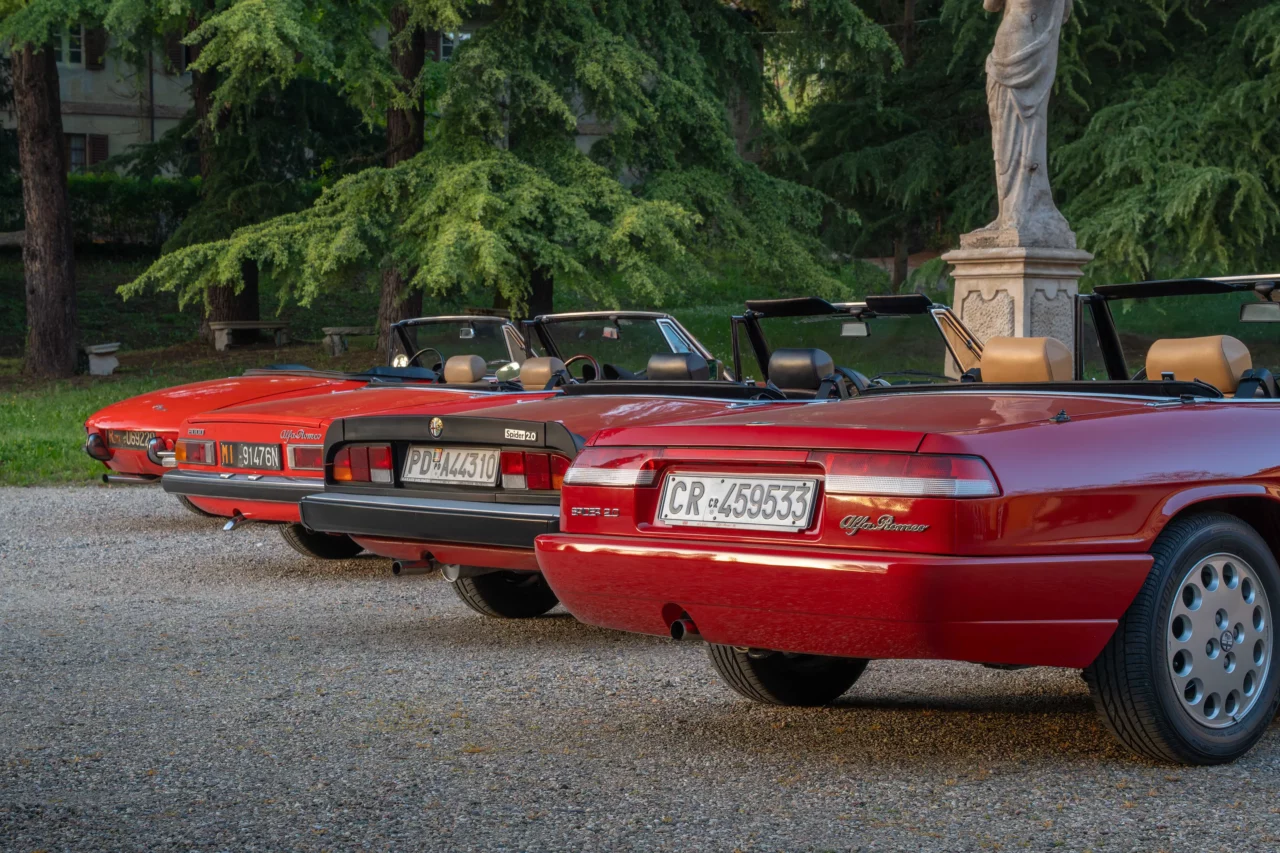
The fourth series (1989–1994) closed the circle, with clean sleek lines that stood as a return to its origins. Models included the 1991 Beauté limited series for the French market and the ‘Commemorative Edition’ to mark the end of Spider Veloce in America after 28 years.
Production took place at two plants – Alfa Romeo in Arese and Pininfarina in Turin – with volumes at each according to market needs and production availability. Produced continuously from 1966 to 1994, it had the longest run of any Biscione model (28 years) and was the most popular ever, with over 124,000 units sold.
Alfa Romeo Classiche: ‘Duetto’ back to its roots
The most eloquent confirmation of the timeless appeal of the Duetto is provided by the collectors’ market, where this model continues to arouse growing, interdisciplinary interest. It is no coincidence that this is one of the cars most frequently entrusted to the Officine Classiche in Turin as part of the Alfa Romeo Classiche program, an unequivocal sign of the extent to which collectors care about restoring these examples to their full and original integrity.
The Alfa Romeo Classiche program is divided into three distinct services:
- Certificate of Origin, which reconstructs the original configuration of the specific model based on the chassis number, certifying the year of production, engine number and details of the bodywork and interior, within the limits of archive documentation
- Certification of Authenticity, to certify the originality of the car and highlight its value through a rigorous process of technical and documentary inspection – verification of company archives, analysis of mechanical and aesthetic components – with the issue of a volume accompanied by photographs, technical documentation and certification plate
- Restoration, ranging from ordinary maintenance to complete restoration according to the original factory specifications, exclusively guaranteed by the car’s designers, developers and manufacturers
Open since 2015, the Officine Classiche workshop is based at the former Mirafiori Workshop 83 on Via Plava, Turin. Spread out over approximately 6,000m2, it is equipped with hoists, specific machine tools and a line for highly accurate finishes, with a cabin specially designed for the painting of individual components.